
Defending Rights in Turbulent Times
Human rights are being targeted. Human rights frameworks face demise due to policy shifts and funding cuts. “In the midst of a rupture,” human rights must serve as a compass and a framework for protection, accountability, and resistance.
Human Rights Compass's next policy brief will contain recommendations to reinforce human rights in the global context of securitisation and conflict.
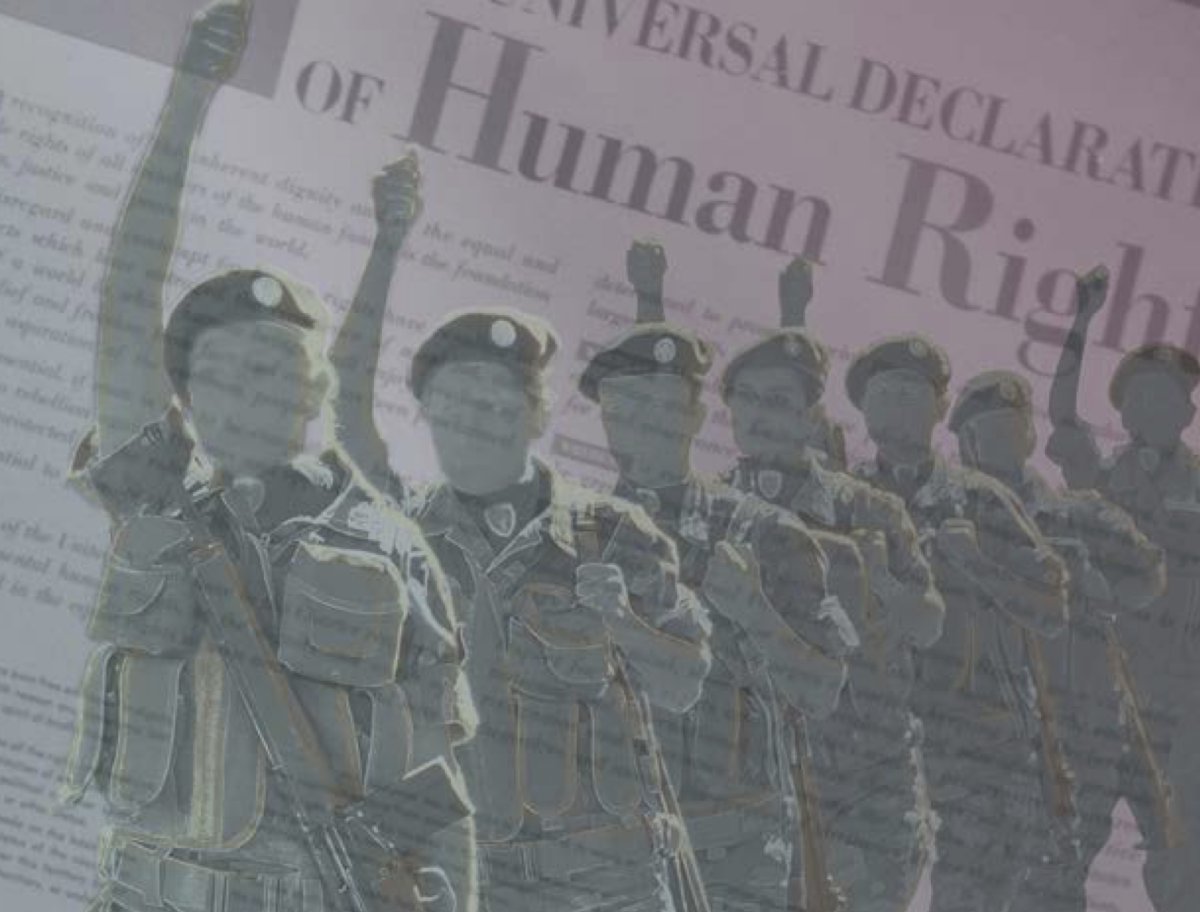
Human Rights Compass is about real-time policy analysis and action. It aims to strengthen human rights as a framework.
Human Rights Compass serves as a platform for real-time human rights policy analysis and strategic coordination through:
» Convening key human rights stakeholders for coordinated policy advice and action.
» Publishing policy briefs and analysis about the Top Human Rights Trends to inform and guide advocacy.
» Promoting principled responses to systemic challenges that undermine international human rights frameworks.
Our convenings brought together over 150 human rights defenders, policy analysts and multilateral actors to examine how the ongoing changes affect international justice, foreign aid and human rights protection, and to promote appropriate solutions.
Human Rights Compass is powered by Progress & Change Partnerships and Palimpsest GmbH.
Human Rights Compass Policy Briefs
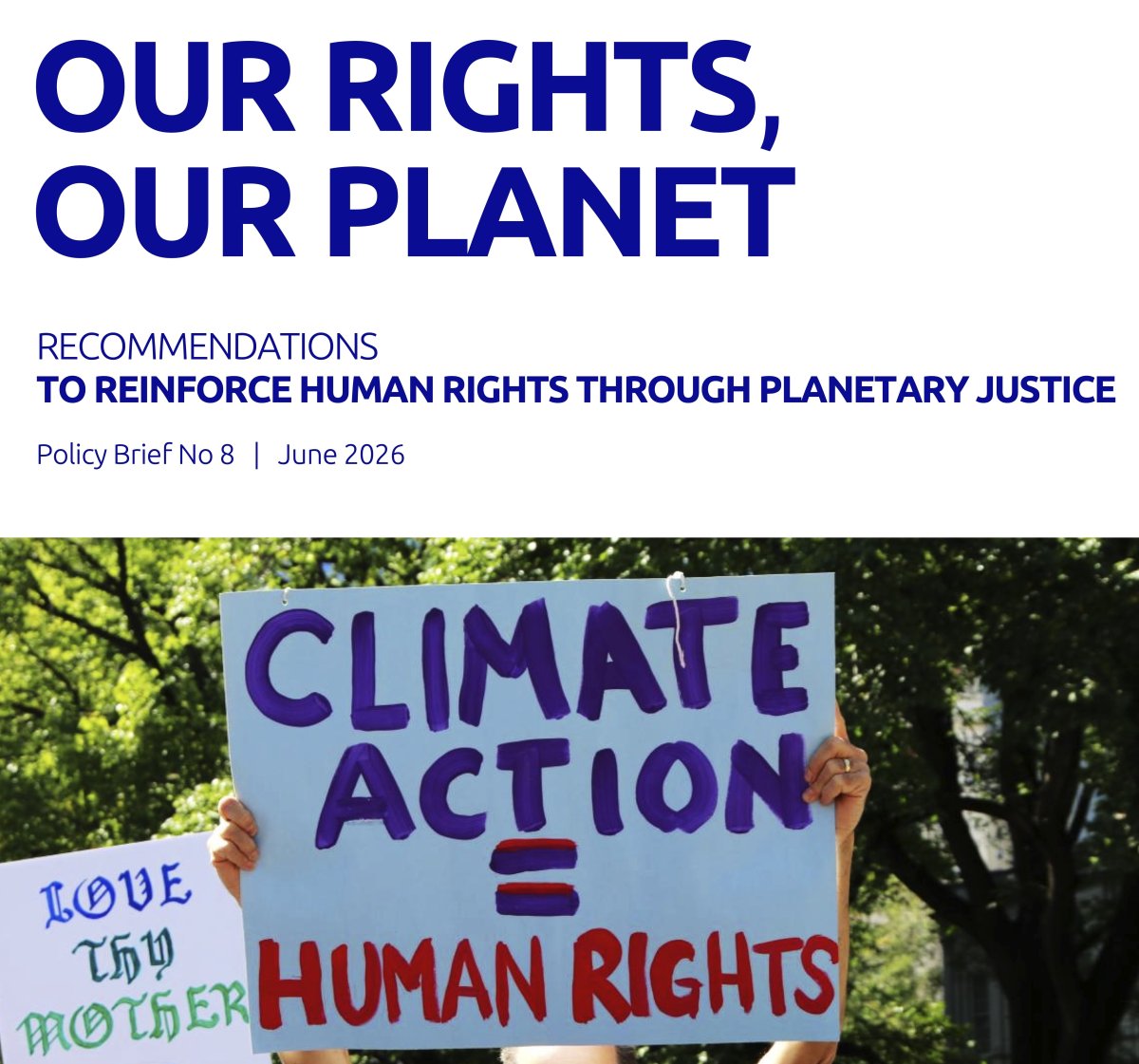
OUR RIGHTS,
OUR PLANET
HUMAN RIGHTS
AT STAKE
DEFENDING DEFENDERS
SAVING LIVES,
UPHOLDING RIGHTS
GLOBAL REALIGNMENT
OUR RIGHTS, OUR PLANET
Recommendations to
Reinforce Human Rights Through Planetary Justice
Human Rights Compass 8th Policy Brief of 2 June 2026, resulting
from a convening of 15 leading international environmental human rights defenders and climate and human rights experts, held on 28 April 2026.
The triple planetary crisis — climate change, pollution, and biodiversity loss — is now the most pressing human rights issue. Attacks on human rights, the rise of autocracy, and the global realignment since 2025 have removed important levers for environmental accountability. Europe's rearmament, economic nationalism, and energy security concerns have crowded out space for climate commitments, whilst civic space has shrunk further. Our Rights, Our Planet sets out why the decisions taken today will determine the rights of future generations, and why the legal architecture for environmental rights has advanced incrementally, from the 2024 KlimaSeniorinnen judgment through the UN General Assembly resolutions of 2022, 2025, and May 2026, to the International Court of Justice affirmation of the right to a clean environment as a norm of international law.
Yet environmental human rights defenders remain amongst the most at-risk groups worldwide. States and corporations use counter-terrorism legislation, public order laws, administrative harassment, and strategic lawsuits to silence advocacy. The human rights community and the climate and environmental justice movements still largely operate in separate spheres. The human rights framework offers the planetary crisis the orientation it lacks: universality, independence from governmental recognition, and established mechanisms for accountability and protection. Climate justice is the new frontier of human rights.
Published ahead of the 1st European Forum on Environmental Human Rights Defenders, Our Rights, Our Planet offers ten recommendationsto protect the environment and human rights, including legal protections, Indigenous representation, and ending the criminalization of environmental protest..
Climate justice is not a secondary concern within human rights work. It is the defining human rights struggle of our time. Without urgent action to integrate human rights and climate justice, and to protect those defending both, societies will continue to fragment and crises will deepen. Recognising this — and acting on it — is essential for progress in both areas.
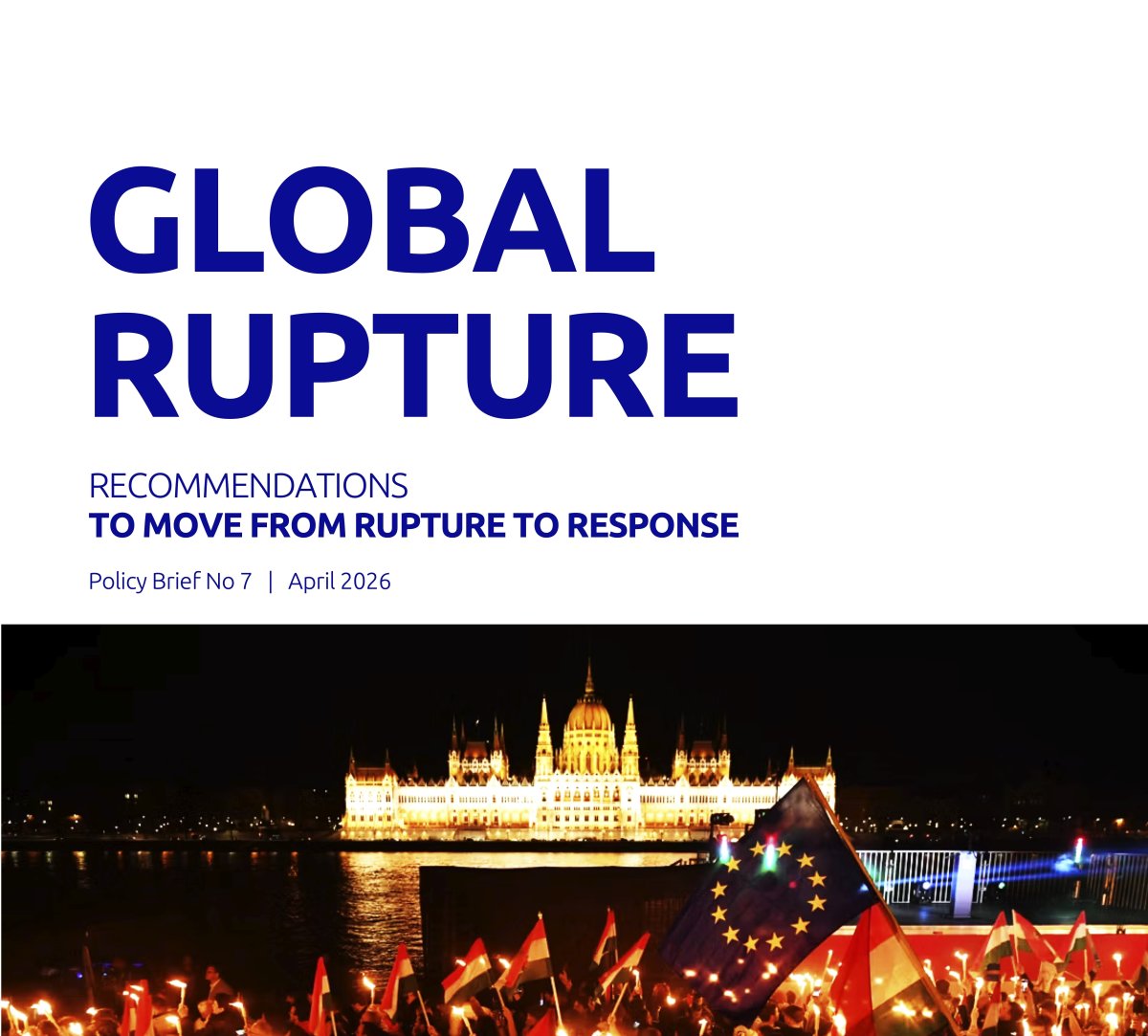
GLOBAL RUPTURE
Recommendations to
Move from Rupture to Response
Human Rights Compass 7th Policy Brief of 21 April 2026, resulting
from a convening of over 25 leading international human rights defenders and experts, held on 31 March 2026.
One year into Donald Trump's second term, the scale and speed of damage to human rights — domestically in the United States and globally — is becoming clearer. The seventh policy brief of Human Rights Compass, Global Rupture, sets out the conditions produced by this accelerating global realignment: the weaponisation of law against critics and migrants; the spread of authoritarian policy templates into established democracies; a collapse in humanitarian funding alongside rising defence budgets; and the deliberate targeting of gender rights and civil society as part of a coordinated political project.
This policy brief also documents the response. Civic mobilisation is growing. The international human rights framework remains intact. The question is whether governments and civil society organisations will act with the urgency the moment requires.
Global Rupture offers seven recommendations and a case study to move from rupture to response: reframing human rights as a security imperative, exposing and contesting the authoritarian playbook, preparing civil societies in established democracies for closing space, investing in the capacity to shape public debate, building broad coalitions that engage non-traditional actors, defending the rights of migrants and refugees, and addressing the gender backlash as the systemic threat it is. The case study examines what is required of Europe specifically, on three levels: foreign policy, funding, and domestic standards.
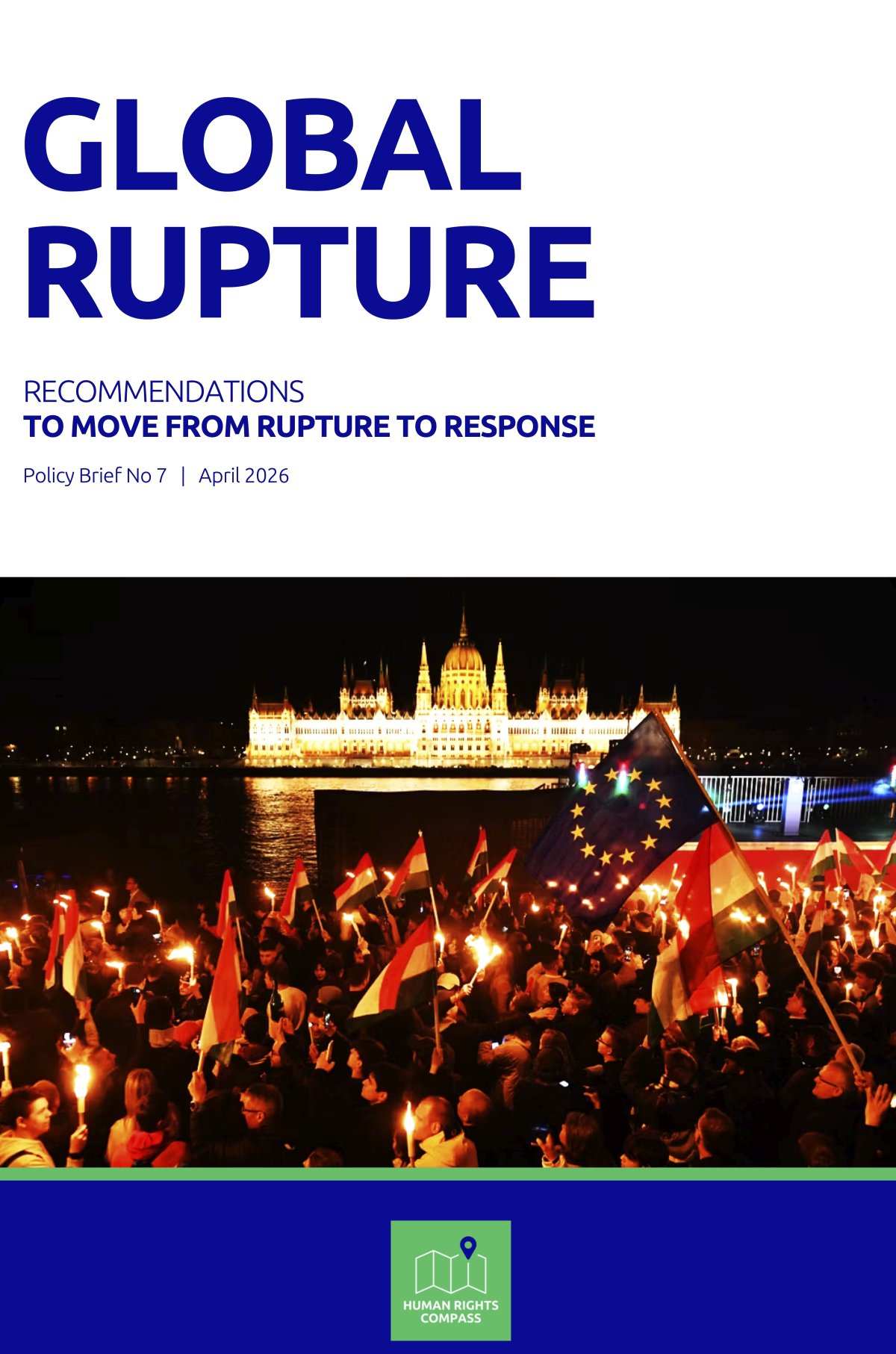
GENDER BACKLASHRecommendations: Advancing Global Gender Equality
Human Rights Compass Policy Brief of 10 December 2025, resulting from a convening of over 25 leading international human rights defenders and experts, held on 28 October 2025.
Across the world, gender equality is facing a deliberate and coordinated backlash. Authoritarian, nationalist and religiously conservative actors are using gender and sexuality to polarise societies, undermine universal human rights, and justify efforts to weaken independent institutions. The Covid-19 pandemic intensified these dynamics by exposing and deepening structural inequalities, pushing women out of formal employment, increasing unpaid care burdens, and worsening domestic and gender-based violence.
What began as isolated pushback has evolved into a structured global campaign to roll back progress amidst a global realignment. Attempts to erase or dilute the term “gender” in international law, the rise in homophobia and anti-LGBTQ mobilisation, and chronic underfunding of gender mandates within multilateral institutions all point to a regressive trend that directly threatens decades of advancement in a fractured order. According to recent global indices, progress on women’s rights and wellbeing has stalled and, in some contexts, reversed.
This backlash does not occur in isolation. It forms part of a wider erosion of multilateralism, including the weakening of humanitarian access, democratic safeguards and climate commitments. When gender equality is treated as optional or negotiable, it is the most marginalised groups who face the greatest harm. Women’s rights organisations, LGBTQ groups and those working to address gender-based violence are increasingly targeted through smear campaigns, criminalisation and funding cuts. Defending these defenders is essential for the health of civic space and the credibility of human rights protection as a whole.
At the same time, there are signals of renewed political will. The Paris Declaration of October 2025 marked a collective recommitment by 31 states to defend women’s and girls’ rights and feminist foreign policies. Turning such commitments into concrete progress will require sustained investment, stronger legal enforcement, coordinated regional action, and leadership at the highest levels of the multilateral system.
Published on Human Rights Day, this policy brief outlines a set of practical recommendations to advance a global gender equality renewal. They aim to support governments, regional institutions and civil society in responding to the backlash with purpose, coherence and ambition. Their implementation is essential for rebuilding a rules-based order in which human rights, democracy and equality reinforce one another.
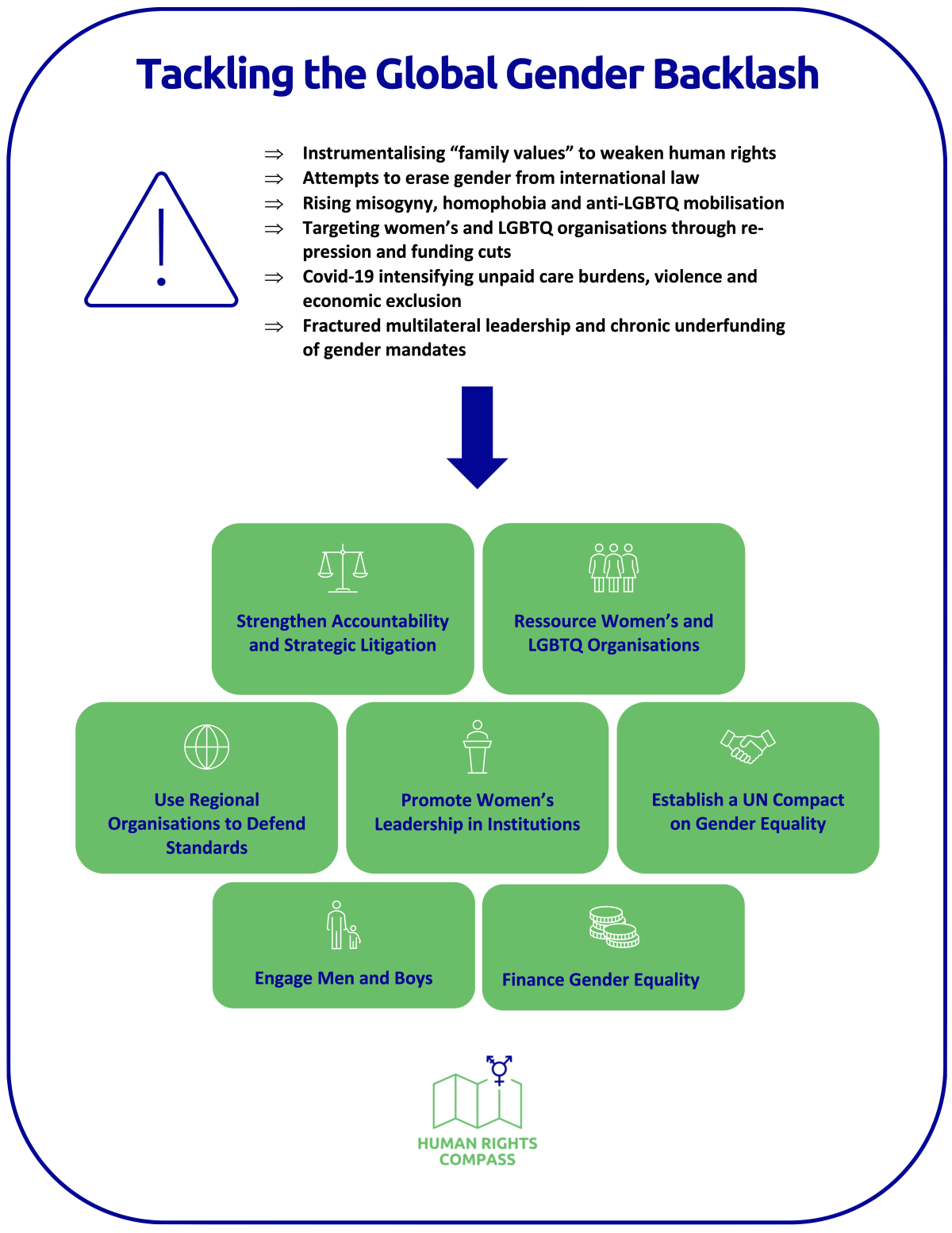
DEFENDING DEFENDERSRecommendations to Strengthen and Support Human Rights Defenders Amid Global Realignment
Human Rights Compass Policy Brief of 26 June 2025, resulting from a convening of over 30 leading international human rights organisations and experts, which was held on 27 May 2025.
We are living through a period of profound “global realignment”. The multilateral human rights system — once grounded in universal norms and collective protection — is fracturing under geopolitical pressure. In this context, human rights defenders (HRDs) and the civic ecosystems that sustain them are at the forefront of democratic resilience.
We are living through a period of profound “global realignment”. The multilateral human rights system — once grounded in universal norms and collective protection — is fracturing under geopolitical pressure. In this context, human rights defenders (HRDs) and the civic ecosystems that sustain them are at the forefront of democratic resilience.
Human rights defenders face a convergence of threats every day, including the rise of authoritarianism, legal repression and disinformation as well as the possible withdrawal of political, diplomatic and financial support from traditional allies. The second Trump administration has accelerated this trend, supercharging aid cuts, weakening human rights diplomacy, and emboldening anti-rights actors worldwide. In Europe, this shift compounds the security recalibration triggered by Russia’s aggression against Ukraine, amplifying the inward turn of official development assistance (ODA) and donor agendas.
Across this “fractured order”, human rights defenders are targeted with increasing impunity. In 2024, at least 625 defenders and media workers — one person in every 14 hours — were killed or disappeared, according to UN OHCHR. Many HRDs face criminalisation, persecution (such as arbitrary detentions, lawsuits attacking public participation, known as SLAPP suits, and legal harassment), surveillance, smear campaigns and other forms of intimidation, and forced exile.
The lack of effective accountability mechanisms leads to impunity, which in turn encourages further violations. Failing to investigate, prosecute, and sanction those responsible for attacks against human rights defenders — whether state, corporate, or non-state actors — perpetuates a cycle of violence, deters engagement in human rights, and erodes public trust in both the prosecutorial systems and the HRDs themselves.
Protecting, strengthening and supporting human rights defenders is a moral imperative. It is also a litmus test of our collective ability to resist authoritarianism, uphold democratic values and restore the integrity of the regional mechanisms and the international system. This policy brief offers all actors of goodwill a set of pragmatic recommendations that are grounded in international norms and anchored in the lived realities of those defending rights and democracy on the ground.
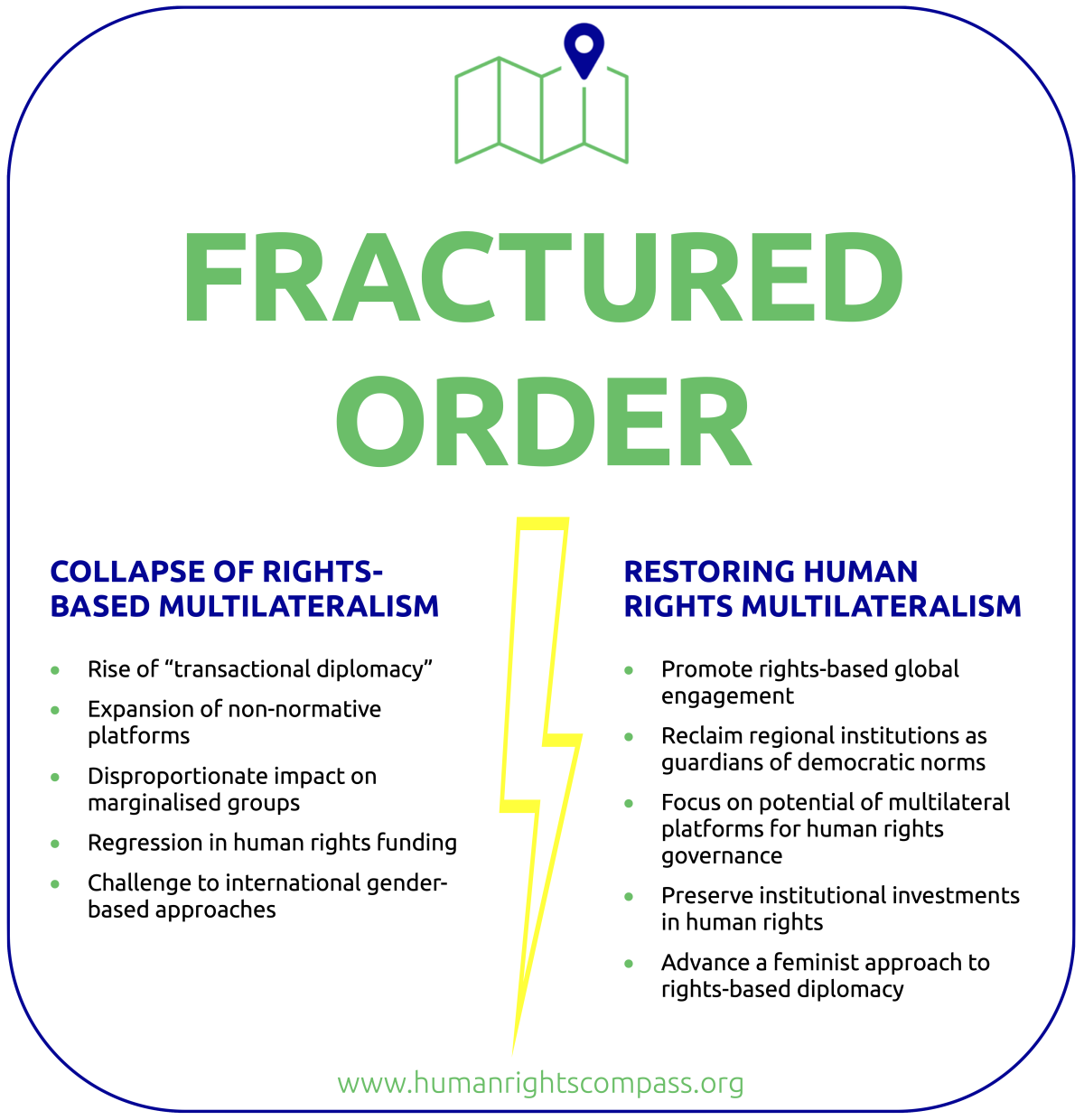
FRACTURED ORDERRecommendations to AdvanceHuman Rights Multilateralism
Human Rights Compass Policy Brief of 12 June 2025, resulting from a convening of over 30 leading international human rights organisations and experts, which was held on 13 May 2025.
The integrity of the international human rights system is under threat as geopolitical realignment accelerates the dismantling of multilateral norms. The collapse of US leadership under the second Trump administration, coupled with consolidation of authoritarianism in Russia, China and their allies, has enabled the deliberate degradation of intergovernmental institutions designed to uphold universal rights.
This crisis is both structural and ideological: the very concept of rights-based governance is being replaced by “transactional” diplomacy, increased securitisation, and regressive nationalist agendas.
Human rights mechanisms — from the United Nations Human Rights Council to regional bodies such as the Organization for the Security and Cooperation in Europe or Council of Europe — are being increasingly undermined by states withdrawing from human rights bodies, reneging on their international commitments, cutting funding, rejecting accountability, and promoting regressive norms. Meanwhile, the rise of non-normative multilateral platforms, such as the Shanghai Cooperation Organisation, has empowered repressive regimes in terms of action and rhetoric.
For over a decade, rights-based approaches have been framed as an existential threat to 'traditional values' and security by authoritarians and populists alike.
Without urgent action, the international community risks becoming entrenched in a dystopian “new normal” where militarisation and exclusion take precedence over the indivisibility and universality of human rights. Only a deliberate effort to restore human rights multilateralism can counter this fractured order.
SAVING LIVES,UPHOLDING RIGHTS
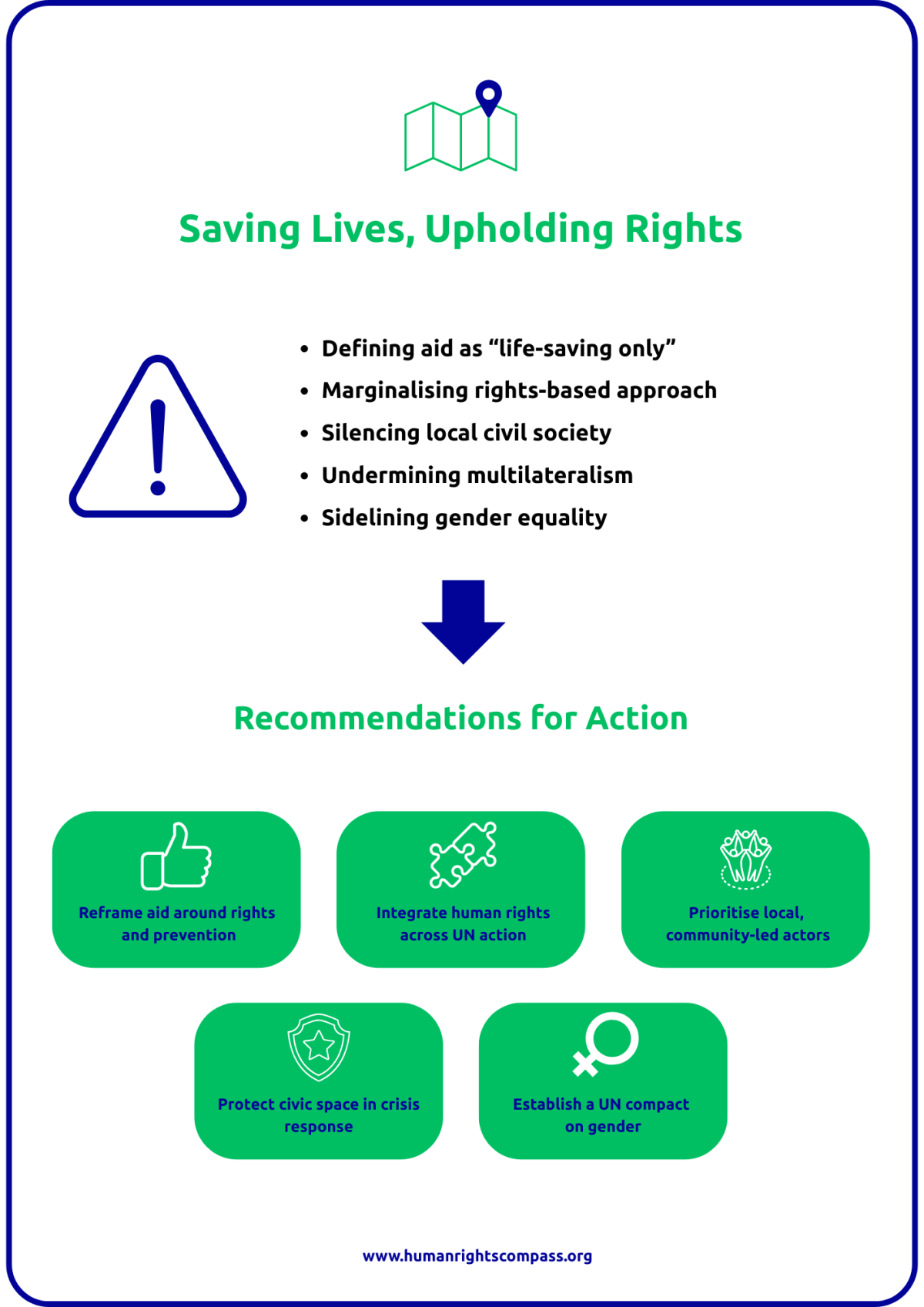
Recommendations to Bridge Humanitarian Aid and Human Rights Amid Global Realignment
Recommendations to Bridge Humanitarian Aid and Human Rights Amid Global Realignment
Human Rights Compass Policy Brief of 12 May 2025, resulting from a convening of over 30 leading international human rights organisations and experts, which was held on 15 April 2025.
The 2025 Global Humanitarian Overview estimated that over 300 million people in 73 countries were in need of humanitarian assistance as of late February 2025 – enduring severe suffering due to protracted conflicts, economic instability, climate emergencies and displacement. Global needs were expected to rise and the funding to decline. At about the same time, the shockwaves of the Trump administration’s decision to abruptly freeze and cancel several types of government funding reverberated through the international humanitarian community.
The 2025 Global Humanitarian Overview estimated that over 300 million people in 73 countries were in need of humanitarian assistance as of late February 2025 – enduring severe suffering due to protracted conflicts, economic instability, climate emergencies and displacement. Global needs were expected to rise and the funding to decline. At about the same time, the shockwaves of the Trump administration’s decision to abruptly freeze and cancel several types of government funding reverberated through the international humanitarian community.
The reduction in foreign aid is global: even countries with a longstanding tradition of donorship have recently “deprioritised” foreign aid funding and plan further cuts.
The proportion of global assistance funding allocated to human rights is modest — and also affected by these cuts. For example, in 2023 almost 45% of USAID foreign aid went to disaster relief, humanitarian aid and vital healthcare programmes, whereas only 3.2% was spent on human rights and the rule of law. In absolute terms, funding for human rights has always been infinitesimal compared to allocations on humanitarian aid. Yet its worldwide impact has been considerable in terms of improving human security.
The increased scarcity of resources caused by the Global Realignment exacerbates a perceived trade-off between humanitarian and human rights work. This risks further marginalising, politicising human rights and reducing related funding. This trend is not limited to authoritarian regimes or populist agendas, but is permeating political and policy dialogues more widely.
To halt this trend, it is urgent to reaffirm that humanitarian crises are also human rights crises, and that humanitarian efforts and human rights work are complementary. It is important – and urgent – to debunk the false dichotomy suggesting that “life-saving” relief can operate outside a rights-based framework or that human rights are disconnected from people’s survival and dignity.
GLOBAL REALIGNMENT
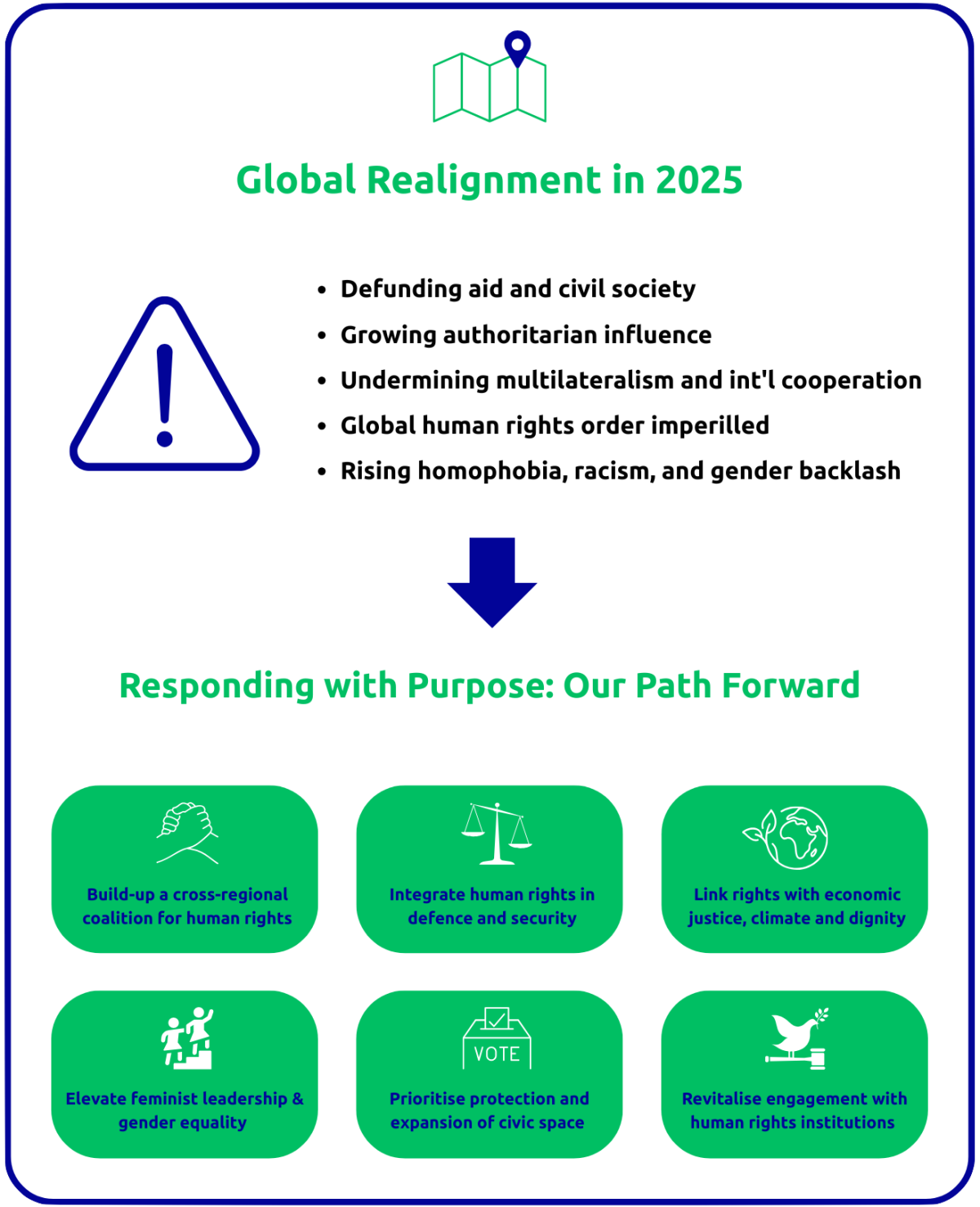
Recommendations on how to avoid an adverse impact on human rights
Human Rights Compass Policy Brief of 15 April 2025, resulting from a convening of over 30 leading international human rights organisations and experts, which was held on 25 March 2025.
The beginning of Donald Trump’s second presidency in the United States is creating, and coinciding with, attacks on the global human rights landscape. Since 20 January 2025, the world has witnessed the erosion of the rule of law in the US and the unravelling of a system that has shaped the international order for the past 80 years — the multilateral rules-based order based on the Franklin Roosevelt blueprint of collective security, economic multilateralism and political self-determination.
In barely two months, the new administration has terminated critical humanitarian aid; withdrawn from international organisations, fora and agreements, notably the climate, health and human rights platforms; curtailed long-standing support for human rights and democratisation efforts abroad; and challenged economic, political and security alliances. It rejected the principles of diversity, equality and inclusion, empowered anti-LGBTQ and racist rhetoric, and accelerated the backlash against gender equality and women’s rights.
The void left by the Trump administration’s approach to democracy, multilateralism, and human rights is immense and requires an urgent response from political leaders and civil society.
New leadership and new frameworks are needed to protect human rights and rule of law in this context. New approaches and new coalitions - on the state and civil society level — should fill the void and human rights must be at the heart of any new order that emerges.
The beginning of Donald Trump’s second presidency in the United States is creating, and coinciding with, attacks on the global human rights landscape. Since 20 January 2025, the world has witnessed the erosion of the rule of law in the US and the unravelling of a system that has shaped the international order for the past 80 years — the multilateral rules-based order based on the Franklin Roosevelt blueprint of collective security, economic multilateralism and political self-determination.
In barely two months, the new administration has terminated critical humanitarian aid; withdrawn from international organisations, fora and agreements, notably the climate, health and human rights platforms; curtailed long-standing support for human rights and democratisation efforts abroad; and challenged economic, political and security alliances. It rejected the principles of diversity, equality and inclusion, empowered anti-LGBTQ and racist rhetoric, and accelerated the backlash against gender equality and women’s rights.
The void left by the Trump administration’s approach to democracy, multilateralism, and human rights is immense and requires an urgent response from political leaders and civil society.
New leadership and new frameworks are needed to protect human rights and rule of law in this context. New approaches and new coalitions - on the state and civil society level — should fill the void and human rights must be at the heart of any new order that emerges.
HUMAN RIGHTS COMPASS
All rights reserved, © Progress & Change Partnerships, 2025