Wars are prolonged rather than resolved. Repression is normalised. And human rights are too often treated as optional commitments, applied when convenient and ignored when costly.

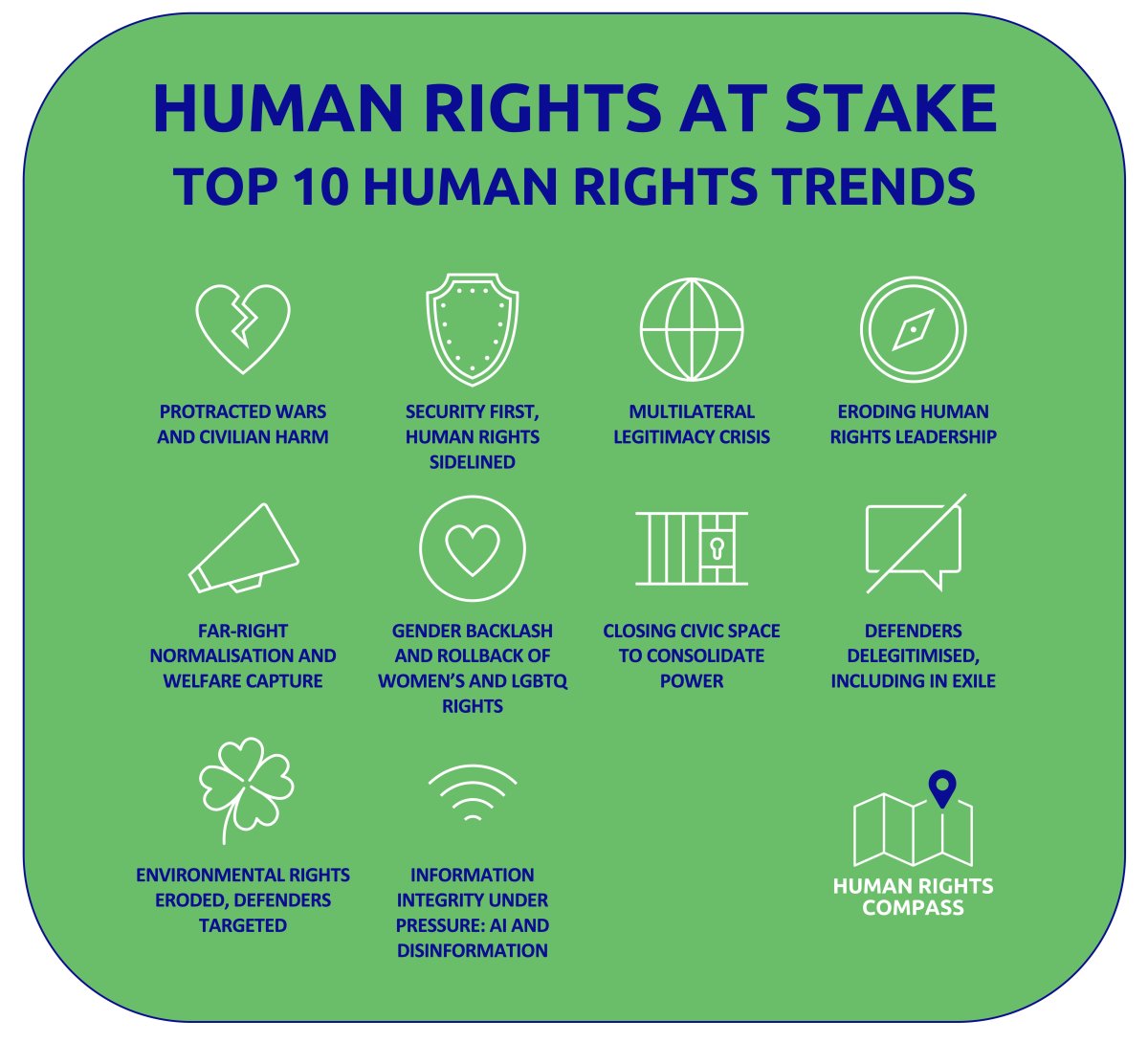
Human Rights Compass published its Top 10 Human Rights Trends ahead of the 61st session of the United Nations Human Rights Council.
The trends we identify show how this shift plays out across regions and institutions.
This pressure is also reshaping democracy and civic life. Civic space is moving from shrinking to a war on NGOs, where funding controls, foreign agent laws, protest bans, digital shutdowns, and violence against civil society actors combine into a model of power consolidation.
At the same time, human rights defenders are being delegitimised, criminalised, and targeted across borders, including in exile. Defending human rights defenders is no longer a specialised concern. It is a test of whether societies still accept independent civic engagement as a public good.
The Top 10 Human Rights Trends also tracks the gender backlash as a central battleground in this moment. Women’s rights and LGBTQ rights are rolled back through law, policy, and coordinated narratives that use gender as a political weapon. This backlash is networked, funded, and strategic. It is also linked to wider attacks on institutions, information integrity, and civic space. When gender equality is framed as negotiable, the wider idea of universality is weakened.
Across all ten trends, the thread is the same: without protection, accountability, and civic participation, insecurity deepens rather than recedes.
1. Protracted Wars, Civilian Harm, and the Erosion of Accountability for Atrocity Crimes▾
Risk: Normalised Violence, Civilian Harm, and the Unravelling of Accountability
Protracted wars are becoming the new normal, with civilians increasingly being targeted. Legal restraints are weakened or ignored, and attacks on civilian infrastructure are normalised. Accountability mechanisms are obstructed, delayed or undermined, including through intimidation of international justice actors. Humanitarian responses are being forced to narrow to “life-saving” action, leaving violations and structural risk factors and root causes of atrocity crises unaddressed and reinforcing impunity.
Risk Mitigation: Reasserting Accountability, Protection, and the Primacy of Law
To counter this trend, accountability must be placed at the heart of civilian protection. States and institutions should reject political deals that trade peace for impunity, defend the independence of international justice, and protect investigators, judges, and prosecutors from retaliation. Humanitarian actors and donors should also establish stronger links between emergency action and human rights protection, including preserving evidence and supporting victims’ access to justice. Accountability must go beyond criminal proceedings and include a full range of forms of political accountability.
At the same time, civilian protection must be embedded in diplomacy and security policy, including stronger controls on arms transfers and monitoring of compliance with international humanitarian law. Local documentation and survivor-led accountability efforts require sustained protection and funding, including for groups active in exile. The message must be consistent: violations do not become acceptable because a war has been ongoing for a long time.
2. The Return of Securitisation and Marginalisation of Human Rights ▾
Risk: Security First, Rights Later
Once again, states are suggesting that we must choose between human rights and security, across areas like migration, protest, public health, climate action, information, and civil society financing. This false dichotomy allows for a simplified introduction of emergency powers, expanded surveillance, and restrictions on dissent, and often frames rights as an impediment to other state interests rather than an integral part of them Over time, states treat rights as conditional commitments that can be withdrawn when they become inconvenient rather than universal obligations. This weakens the rule of law, with marginalised groups and defenders bearing the brunt of the impact.
Risk Mitigation: Reclaiming Human Security and Democratic Resilience
To counter this trend, we must reject the idea that societies choose between security and rights. Security frameworks must include civil liberties safeguards, parliamentary scrutiny, and judicial oversight from the start, not as an afterthought, reviving the idea of “human security.” Policies should be reframed around this broader conception of security, including social protection, civic participation, independent media, and trust in institutions.
Human rights defenders should be recognised as partners in prevention and resilience, rather than being viewed as risks to be managed. Oversight bodies and courts need resourcing and political support to stop emergency measures from becoming permanent. The Women, Peace and Security agenda must remain central to security thinking, because gender-blind securitisation deepens exclusion and instability.
3. The Crisis of Multilateral Legitimacy and the Turn to Coalitions of the Willing ▾
Risk: Fragmented Multilateralism and the Normalisation of Selective Cooperation
Multilateral institutions are widely perceived as slow and politicised, and as being unable to protect people in times of crisis. Though they often remain the only place for victims to go, it is the absence of political follow up that limits their effectiveness. States withdraw, defund, and undermine these institutions, which also fail to follow through on clear warning signs. In response, coalitions of the willing are promoted as a pragmatic alternative, but they often lack accountability and exclude affected communities. This normalises selective cooperation and makes protection contingent on geopolitics rather than law. Building such coalitions outside of the UN context also requires establishing contacts with numerous governments beyond Europe and North America as well as an in-depth understanding of their positions on various human rights issues.
Risk Mitigation: Rebuilding Legitimacy Through Accountability, Inclusion, and Political Courage
To counter this trend, we must reject the false dichotomy of paralysed multilateralism and unaccountable coalitions. Multilateral bodies require more robust political follow-up and follow-through mechanisms, alongside systematic engagement with local civil society and clearer political consequences for ignoring warnings. Human rights mechanisms also require predictable funding and collective political defence when attacked or intimidated.
Coalitions of the willing, where they exist, should be transparent, bound by international human rights law and accountable to multilateral oversight. Regional systems should be reinforced as practical pillars of protection and accountability. States that claim to support multilateralism must show it in practice, even when it incurs political costs, and should collaborate with civil society groups across countries.
4. The Erosion of Human Rights Leadership and Political Lethargy ▾
Risk: Strategic Drift and the Quiet Retreat from Leadership
Although Europe’s human rights commitments remain strong on paper, political will is weakening and leadership is hesitant at the level of European states, the Council of Europe, and the European Union. Attacks on the European Court of Human Rights (ECtHR) and the Convention system are growing and human rights are treated as negotiable in the face of security, migration, and far-right electoral pressure. This undermines public trust in and understanding for those institutions and creates space for authoritarian influence.
Risk Mitigation: Rebuilding European Leadership through Credibility and Action
Europe must treat human rights as a strategic interest linked to democratic resilience and long-term security. This requires defending its own legal architecture unequivocally, including the Council of Europe, the authority of the European Court of Human Rights and full implementation of its judgments. Migration and security policies should be shaped by human rights-based approaches, not by copying exclusionary narratives that legitimise far-right framing.
Europe also needs to rebuild public trust, with civil society as a partner and an early warning system. Consistency is paramount in external relations; double standards corrode influence and undermine the case for international law. Leadership is restored through choices that show human rights are not optional when the pressure rises.
5. The Normalisation of Far-Right Populism and Its Appropriation of Protection and Welfare Narratives ▾
Risk: Protection Rhetoric, Human Rights Rollback
Far-right populism is moving from the margins into government, administration and mainstream debate. It redefines “protection” and “welfare” to justify exclusion, harsh policing, and conditional access to rights. It also fuels identity-based grievances, including framing of racism as “defending” those who are perceived as being treated unfairly, as well as a politics of masculinity that targets gender equality and LGBTQ rights. Antisemitism is being manipulated in complex ways; some actors are claiming to combat it, yet are enabling antisemitic narratives and alliances.
Risk Mitigation: Rebuilding Trust Without Surrendering Rights
To counter this trend, social protection and solidarity should be reclaimed as a human rights project, based on universal social security, robust public services, equitable taxation, and dignified working conditions. Democratic institutions should treat the normalisation of the far right as a governance risk and strengthen safeguards against discrimination, protecting the courts, regulators, and the integrity of elections and media spaces.
Responses to antisemitism must be consistent and credible integrated into wider efforts to combat racism, discrimination and xenophobia, and far-right actors must not be allowed to exploit the fight against antisemitism to advance racist and conspiratorial politics. Civil society also needs a stronger local presence and to forge alliances with groups beyond traditional human rights circles, such as unions, community and faith groups and professional associations. This is how exclusionary narratives lose their grip on everyday life.
6. The Global Gender Backlash and the Rollback of Women’s and LGBTQ Rights ▾
Risk: Gender as a Political Weapon
Women’s rights and LGBTQ rights are being rolled back through law, policy, and coordinated public narratives that portray equality as a threat. Gender and sexuality are used as political tools to polarise societies and justify institutional capture and executive overreach. Far-right actors often use “protection” rhetoric to target education, bodily autonomy, and LGBTQ visibility, while presenting themselves as defenders of social order. The result is that discrimination and violence become easier to deny, and the idea that some rights are optional gains ground.
Risk Mitigation: Protect Rights Infrastructure; Resource Resistance; Rebuild Legitimacy
To counter this trend, gender equality and LGBTQ rights must be treated as core democratic infrastructure. Rolling out monitoring and strategic litigation, with real follow-up on the implementation of judgments, is essential. Defenders and organisations facing smear campaigns, criminalisation, and funding cuts require flexible, multi-year support and a rapid response to threats.
The response also must counter “protection” narratives with rights-based protection: survivor-centred services, evidence-based education, and policies that reduce violence without scapegoating. Gender must remain central in peace and security, climate, and digital agendas, backed by budgets and political leadership rather than mere statements. Broad coalitions are essential, because anti-gender mobilisation is networked, funded, and strategic.
7. The Consolidation of Power Through the Closure of Civic Space ▾
Risk: From Shrinking Space to a War on NGOs
The cumulative effect of restrictions on civic space is now creating a new reality. Funding restrictions, “foreign agent” laws, securitisation, surveillance, protest bans, digital shutdowns, smear campaigns, persecution and violence directed at civil society actors are no longer isolated tools. Together, they sustain a model of governance based on power consolidation, in which independent civic engagement is viewed as a threat to be contained or eliminated. This approach is central to the illiberal, autocratic playbook promoted by China and Russia and replicated across regions. Civic space is being deliberately closed, with fear being used as a tool.
Risk Mitigation: Defending Civic Space as Democratic Infrastructure
To reverse this trajectory, civic space must be treated as core democratic infrastructure, not a policy preference. International actors should recognise patterns for what they are: systemic power consolidation, not technical regulation. Early and collective responses are crucial before closure becomes total. Benchmarks for civic space should be incorporated into foreign policy, security cooperation, trade partnerships and development agreements, with clear consequences for restrictions on freedom of association and protest rights, and for the persecution or attack on civil society actors.
Donors and institutions committed to democracy and human rights should stabilise and reconfigure their support for independent civil society. This should include flexible, multi-year core funding, rapid response and legal defence support, emergency relocation, and protection funding as a standard, not an exception. In parallel, civil society needs to strengthen its local presence and forge alliances to counter delegitimisation and demonstrate its relevance. Protection and solidarity networks are part of this work. The message must be consistent: independent civil society does not threaten stability; it is a prerequisite for accountability, participation and resilient societies.
8. The Delegitimisation of Human Rights Defenders, Including Those in Exile ▾
Risk: Delegitimisation, Persecution, and Criminalisation
People on the frontlines of rights struggles, representing their communities and organising resistance, are increasingly subjected to delegitimization, as well as arrests and surveillance. These human rights defenders (HRDs) are portrayed as foreign agents, extremists, or self-interested elites, which makes repression easier to justify and harder to contest. For defenders in exile, stigma is paired with transnational repression, harassment of family members, cyberattacks, and the misuse of legal cooperation tools. This weakens solidarity, undermines access to protection, and erodes the early warning role that defenders play.
Risk Mitigation: Rebuilding Legitimacy, Protection, and Solidarity
To counter this trend, states and institutions must treat human rights defenders as legitimate public interest actors and consistently affirm this status at home and abroad, even when defenders are unpopular or politically inconvenient. Protection frameworks must also adapt to transnational repression, responding more strongly to cross-border harassment, spyware, strategic lawsuits, and the misuse of extradition or policing tools. Exile should not add to the vulnerability of human rights defenders.
Funding should support not only emergency response, but also invest in sustainability and legitimacy of HRDs, their communications, community connection, and organisational continuity. Multilateral and regional mechanisms should treat delegitimization campaigns as early warning indicators of wider democratic erosion. Civil society also needs to form broader alliances that ground human rights work in shared social struggles.
9. The Erosion of the Right to a Safe, Clean, Healthy and Sustainable Environment ▾
Risk: Environmental Rights Under Pressure, Environmental Defenders Under Attack
Although environmental rights are recognised in law, they are often sidelined in practice when they clash with economic priorities, energy politics, or short-term stability claims. Environmental defenders are increasingly being criminalised, facing strategic lawsuits against public participation (SLAPP), surveillance and administrative harassment — even in democratic states. Protest is reframed as disorder and civil disobedience as extremism, creating a chilling effect, rather than a vital voice in building public support for climate change mitigation. This delays solutions, deepens social conflict and harms communities already bearing the brunt of environmental damage.
Risk Mitigation: Defending Environmental Rights as Core Human Rights
To counter this trend, the right to a healthy environment must be integrated into domestic law, policy and enforcement, including meaningful access to justice and remedies. Governments should stop criminalising peaceful environmental activism and adopt strong protections to prevent litigation from being used as a weapon to stifle participation. Environmental defenders should be explicitly covered by environmental and human rights defender protection mechanisms, including emergency support and safeguards against transnational repression.
Environmental policy must also be founded on participation and social justice, because just transitions fail when communities are excluded. Regional and international bodies should treat attacks on environmental defenders as an early warning signal of a broader regression of rights and act quickly. Protecting environmental defenders is not a niche cause; it is an integral part of safeguarding democratic space and a liveable future.
10. Information Integrity Under Pressure: AI, Disinformation, Propaganda, and Movement Gaps ▾
Risk: Information as a Battlefield, Facts as the First Casualty
Information spaces are increasingly treated as battlefields, being shaped by disinformation, propaganda, and AI-driven manipulation. Facts and evidence are undermined through repetition and doubt rather than by credible counterevidence. This has an impact on elections, war reporting and accountability for violations, because when facts are blurred, it becomes more difficult to establish responsibility. Human rights movements often lack the infrastructure and reach to compete in such polarised information environments.
Risk Mitigation: Rebuilding Information Integrity
To counter this trend, we must defend the conditions in which facts can be established, tested, and used to hold those in power to account. Information integrity is a human rights issue linked to participation, access to justice, and freedom of expression. Rather than taking shortcuts that create new tools for abuse, responses should strengthen transparency and accountability for coordinated manipulation, as well as safeguards against AI-enabled surveillance and profiling.
Civil society requires sustained investment in communications capacity, verification workflows and rapid response anchored in evidence. Independent media outlets, fact-checkers and local trusted intermediaries require protection and financial sustainability. Partnerships with educators, technologists, and community communicators could also help build shared reference points and ensure that facts are not drowned out by noise.
Human Rights Compass offers this as a practical tool. It is designed to support well-intended governments, policy-makers, institutions, and civil society in reading the landscape clearly, defending what is under attack, and acting with more consistency and political courage in a fractured order.
Human Rights Compass Policy Brief of 19 February 2026, resulting from a convening of over 30 leading international human rights defenders and experts, held on 25 November 2025.
HUMAN RIGHTS COMPASS
All rights reserved, © Progress & Change Partnerships, 2025