
We live along faultlines: places where rights, power, and principles collide.
Some cracks are loud. Others are quiet.
Through Notes from the Faultline, our Research Lab offers exclusive reflection on the global and local tensions shaping civic space, democracy, and human rights.
We look at work across institutions, crises, and coalitions.
Our analysis is rooted in Progress & Change Partnerships' engagement with partners who are holding the line.
Follow Notes from the Faultline
HUMAN RIGHTS HOLD
THE WORLD TOGETHER
The great powers are leaving the rules they wrote to others: the United States have withdrawn from the UN's human rights mechanisms and sixty-six international organisations; Russia's war of aggression on Ukraine continues ; China works inside the United Nations to redefine international law around sovereignty. The UN80 reform has cut close to one sixth of the posts at the UN Human Rights Office.
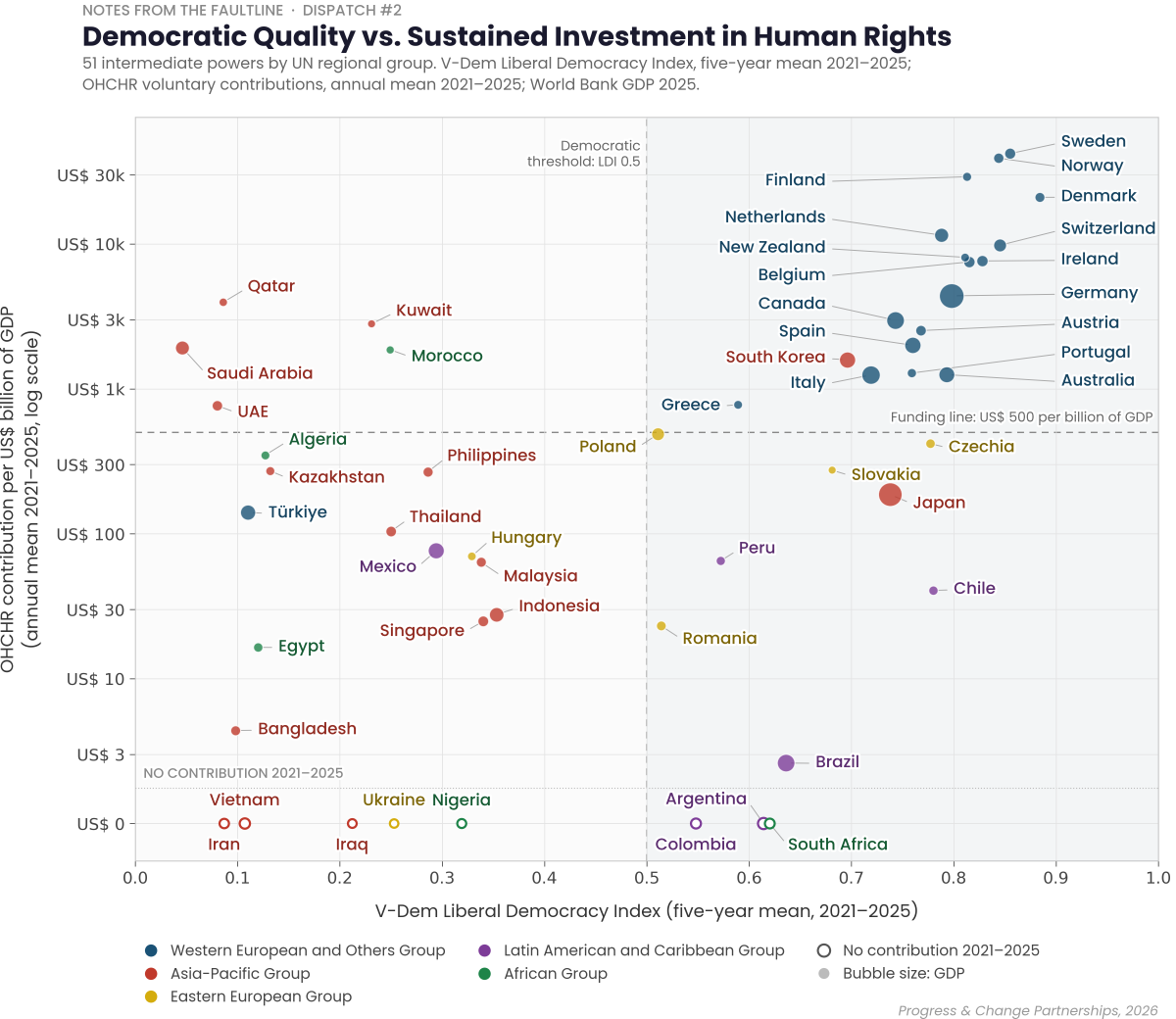
Dispatch #2 argues that intermediate powers, states with weight but without the capacity to impose, now carry the defence of the universal standard. Pairing democratic quality with funding of the Office across 51 intermediate powers, it identifies the eighteen states best placed to lead and sets out seven benchmarks:
- Treat democracy and human rights as a security interest
- Defend universality, including the right to take part in public affairs, with a new UN Special Rapporteur on democracy
- Protect and fund the human rights pillar, through a pledge of 0.001 per cent of GDP
- Build a coalition of the willing for democracy and human rights drawn from every region
- Use the General Assembly and the full Charter toolbox, starting with the Security Council of 2027
- Make human rights central to the next Secretary-General
- Lead with consistency and accept measurement of your own record
Human rights hold the multilateral order together. Defending them is within the reach of intermediate powers acting together.
The foreword to the Dispatch is written by Oleksandra Matviichuk, Ukrainian human rights lawyer, head of Centre for Civil Liberties 2022 Nobel Peace Prize Laureate.
The afterword is signed by Odette McCarthy, Executive Director of Equitas: International Centre for Human Rights Education, 2024 recipient of The Karen Takacs Award
LEADERSHIPIN A FRACTURED ORDER
As the United Nations marks its 80th anniversary, the multilateral order is in deep crisis. Wars in Ukraine, Gaza and Sudan continue, the Security Council is paralysed, major powers openly defy the Charter, and budget cuts are forcing UN agencies to reduce life-saving operations. Rival blocs such as the Shanghai Cooperation Organisation promote themselves as alternatives to a “Western-led” multilateralism, while states withdraw from key treaties and question the UN’s relevance. The organisation is seen as being in “free fall” — short of resources, relevance and unity — caught in what may well become a “lost decade for humanity.”
Notes from the Faultline: Dispatch #1 argues that the 2026 appointment of the next United Nations Secretary-General will be a defining test of the organisation’s legitimacy. The process must be transparent, rules-based and inclusive, and the outcome must deliver leadership able to restore credibility and shape a new post-2030 agenda grounded in human rights, climate action and peace.
Four benchmarks frame this argument:
In 2026, legitimacy and leadership converge: the United Nations must choose a woman from the Eastern European Group to lead it through the next decade.
Notes from the Faultline: Dispatch #1 argues that the 2026 appointment of the next United Nations Secretary-General will be a defining test of the organisation’s legitimacy. The process must be transparent, rules-based and inclusive, and the outcome must deliver leadership able to restore credibility and shape a new post-2030 agenda grounded in human rights, climate action and peace.
Four benchmarks frame this argument:
- Prioritise Human Rights, Climate Change and Post-2030 Credibility.The next Secretary-General must defend human rights, confront democratic backsliding and gender backlash, and lead on climate action to rebuild trust in multilateralism.
- Appoint a Woman to Lead a Global Gender Renewal.After eighty years of all-male leadership, appointing the first woman Secretary-General is not symbolic but structural — a test of whether the UN can live up to its own principles and stand against the global anti-rights backlash.
- Appoint a Woman from the Eastern European Group.No Secretary-General has ever come from this region. A woman from the Eastern European Group would close both gender and regional gaps, bringing lived experience of war, transition and reconciliation essential to the UN’s renewal.
- The General Assembly Should Play Its Full Role.The Assembly must uphold its revitalised powers, ensure transparency, and guard against a return to back-room bargaining.
In 2026, legitimacy and leadership converge: the United Nations must choose a woman from the Eastern European Group to lead it through the next decade.
